

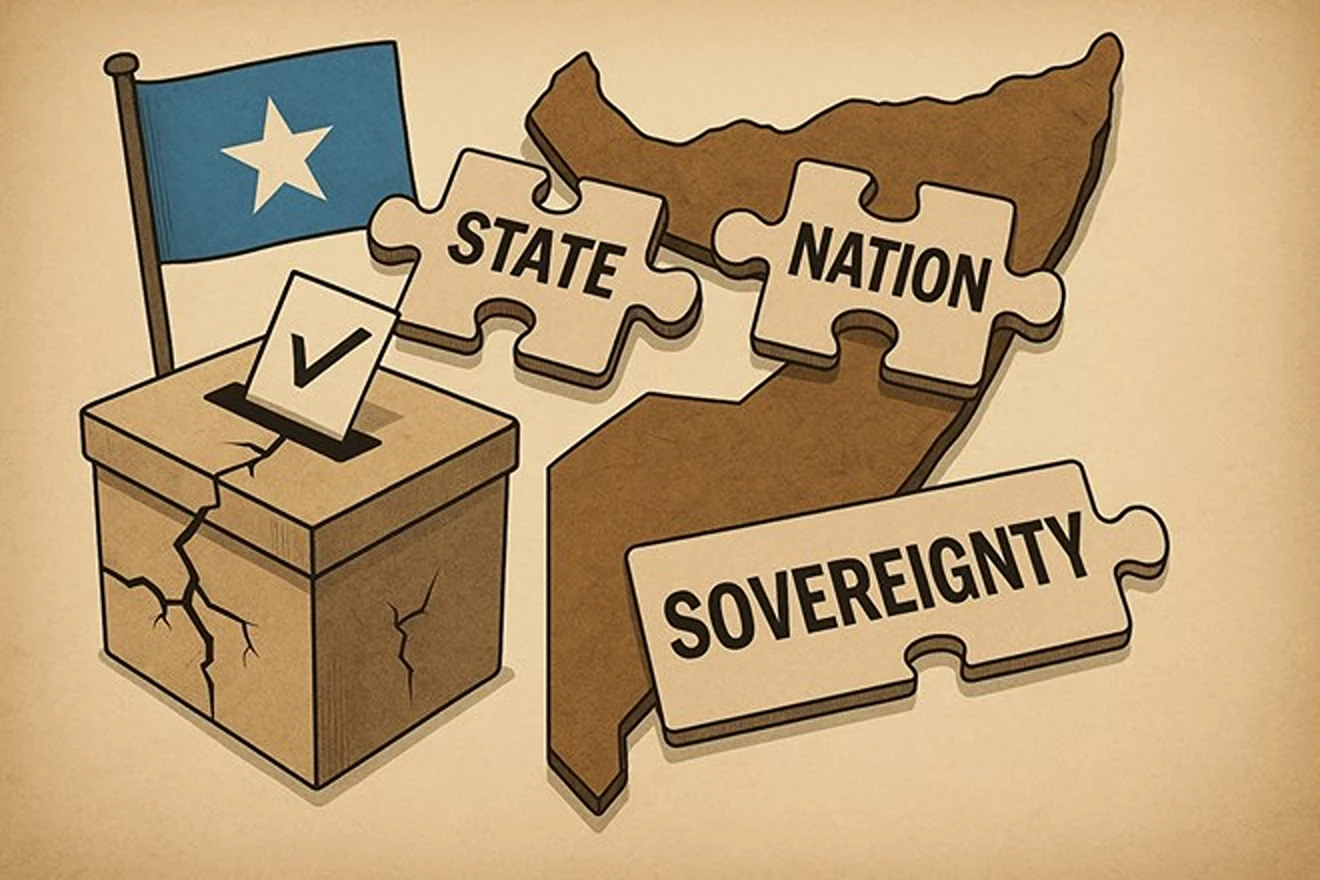
For much of the modern era, sovereignty appeared relatively straightforward. A state possessed territory, exercised authority over a population and was recognised by other states. In legal terms, sovereignty was something a country either had or did not have.
The contemporary international system makes that distinction increasingly difficult to sustain.
A government can remain formally sovereign while depending on foreign military protection, imported technology, external financial markets or digital infrastructure controlled abroad. Conversely, a small state with limited military and economic resources may retain considerable room for manoeuvre by exploiting diplomacy, culture, law, technology or carefully constructed international relationships.
The important question is therefore changing. It is no longer simply whether a state is sovereign, but how much sovereign agency it can actually exercise, through which mechanisms, and under what conditions.
Recent research by the International Burke Institute offers one way of approaching this problem. Its sovereignty framework treats sovereignty as a multidimensional phenomenon rather than a single institutional attribute, assessing states across seven dimensions: political, economic, military, technological, informational, cultural and cognitive sovereignty.
The value of this approach does not lie merely in producing another international ranking. Its more significant implication is conceptual: sovereignty is better understood as a system of interacting capacities whose strength can change over time.
Beyond the illusion of complete autonomy
This distinction matters because sovereignty and independence are often treated as synonyms.
In practice, almost no contemporary state exercises complete autonomy. Global supply chains link national economies. Defence partnerships distribute security functions across borders. Cloud infrastructure and semiconductor production create technological dependencies. International financial markets constrain domestic economic decisions. Migration and diasporas complicate the relationship between territory, citizenship and political community.
Yet dependence does not automatically eliminate sovereignty.
Indeed, one of the more interesting implications of the concept of emergent sovereignty is that relationships conventionally described as dependencies can sometimes increase a state’s practical capacity to act.
Small states illustrate the point particularly well.
Tuvalu faces an existential physical challenge from climate change. In a conventional territorial understanding of sovereignty, the erosion of habitable land could eventually threaten one of the material foundations of statehood itself. Its response, however, has not been confined to physical adaptation. Tuvalu has also pursued legal and diplomatic mechanisms designed to preserve the continuity of its statehood and maritime entitlements even if its geography changes.
This is sovereignty being produced through international law and diplomacy rather than territorial power alone.
Cape Verde offers a different model. Its diaspora has become part of the country’s political and economic architecture, connecting a relatively small resident population to external networks of capital, representation and cultural influence. What might once have been described simply as demographic dependence can therefore also become a source of political resilience.
Tonga offers yet another configuration, combining monarchical continuity, cultural identity and increasingly visible climate diplomacy.
These cases suggest that sovereignty is not necessarily weakened whenever power crosses borders. The more useful question is whether a state can organise external relationships in ways that expand or restrict its future choices.
Sovereignty is uneven
The multidimensional approach also exposes a second problem with traditional measurements of state power: national capabilities are rarely distributed evenly.
A country may possess exceptional economic sovereignty and very limited military sovereignty. Another may enjoy significant technological capacity but remain exposed to foreign capital or critical imports. A third may have weak formal institutions while maintaining unusually resilient cultural cohesion.
Consider Monaco. The framework depicts a state with extremely strong political and economic dimensions but very limited autonomous military capacity. Its security dependence does not prevent Monaco from functioning as a highly effective sovereign actor because wealth, institutional continuity, international recognition and external security arrangements reinforce one another.
That arrangement works precisely because sovereignty is systemic.
If sovereignty were simply the sum of independently accumulated national capabilities, military dependence would necessarily make Monaco dramatically less sovereign. Instead, weaknesses in one field can sometimes be compensated for by strength or carefully structured relationships in others.
The reverse is also true.
Technological strength, for example, can create new vulnerabilities when it relies on concentrated foreign markets, components or capital. Military alliances can provide security while narrowing diplomatic freedom. Foreign investment can expand productive capacity while increasing exposure to decisions made outside national institutions.
The dynamics of sovereignty therefore matter at least as much as its level at any particular moment.
From measurement to agency
This is where a static sovereignty index can develop into a broader theory of sovereign agency.
Imagine two states receiving similar aggregate sovereignty scores. Their strategic situations could still be profoundly different.
One state might possess relatively balanced capabilities across all seven dimensions. The other might combine extraordinary economic and technological strength with severe military or informational dependence.
A geopolitical shock would affect them differently.
The question for policymakers should therefore not simply be: How sovereign are we?
It should be: Which dependencies reduce our ability to choose, which dependencies increase it, and how quickly can the structure change?
That shift has practical consequences.
Governments pursuing strategic autonomy frequently treat sovereignty as an accumulation problem: build more domestic industry, produce more energy, localise more data, expand military capacity and reduce imports.
Some of those measures may be sensible. But complete self-sufficiency is neither realistic nor necessarily desirable. Attempting to remove every dependency can be enormously expensive and may create new vulnerabilities of its own.
A dynamic sovereignty strategy would instead distinguish between manageable interdependence and strategic dependence.
The first preserves alternatives. The second progressively eliminates them.
The danger of measuring what cannot be separated
There are, however, limitations to multidimensional models.
Assigning numerical scores to concepts such as cultural or cognitive sovereignty inevitably involves methodological choices. Different political traditions may disagree about what should count as autonomy, resilience or state capacity. Composite rankings can also conceal causal relationships: two states may receive similar scores for entirely different structural reasons.
There is also a danger of turning sovereignty into a policy objective without asking what it is for. A highly autonomous state is not necessarily prosperous, democratic or peaceful. Sovereign capacity describes the ability to act; it does not determine whether that capacity will be used well.
For precisely that reason, multidimensional indexes should be treated as analytical instruments rather than definitive judgements about the success of states.
Their most useful contribution may be diagnostic.
They make visible what conventional measures such as GDP, military expenditure or formal institutional stability often miss: the interaction between different forms of national capability and dependence.
Sovereignty as the preservation of choice
The international system is unlikely to return to a world in which sovereignty can plausibly mean insulation from external influence.
Artificial intelligence, financial networks, climate change, global infrastructure and increasingly contested information systems will make states more interconnected, not less.
The defining characteristic of sovereignty in such a system may therefore be neither isolation nor absolute control.
It may be the capacity to preserve meaningful choice under conditions of interdependence.
That is what makes the idea of emergent sovereignty useful. It shifts attention from the formal possession of sovereign rights to the processes through which effective political agency is continually created, lost, compensated for and reconstructed.
The sovereign states of the coming decades will not necessarily be those that depend least on others.
They may instead be those that understand their dependencies best – and retain the capacity to change them.