

London’s FTSE 100 (^FTSE) closed marginally higher on Tuesday, bucking a broader trend of weakness across European and American equity markets driven by technology stock declines.
The FTSE 100 finished the session up 14.11 points, or 0.1%, closing at 10,665.88, while the FTSE 250 dropped 125.40 points, or 0.5%, to end at 23,378.82.
The AIM All-Share also declined, falling 9.56 points, or 1.2%, to close at 769.18 as smaller-cap stocks came under pressure.
European markets fared worse, with Paris’s Cac 40 ending down 0.5% and Frankfurt’s Dax 40 dropping a steeper 1.4% on the day.
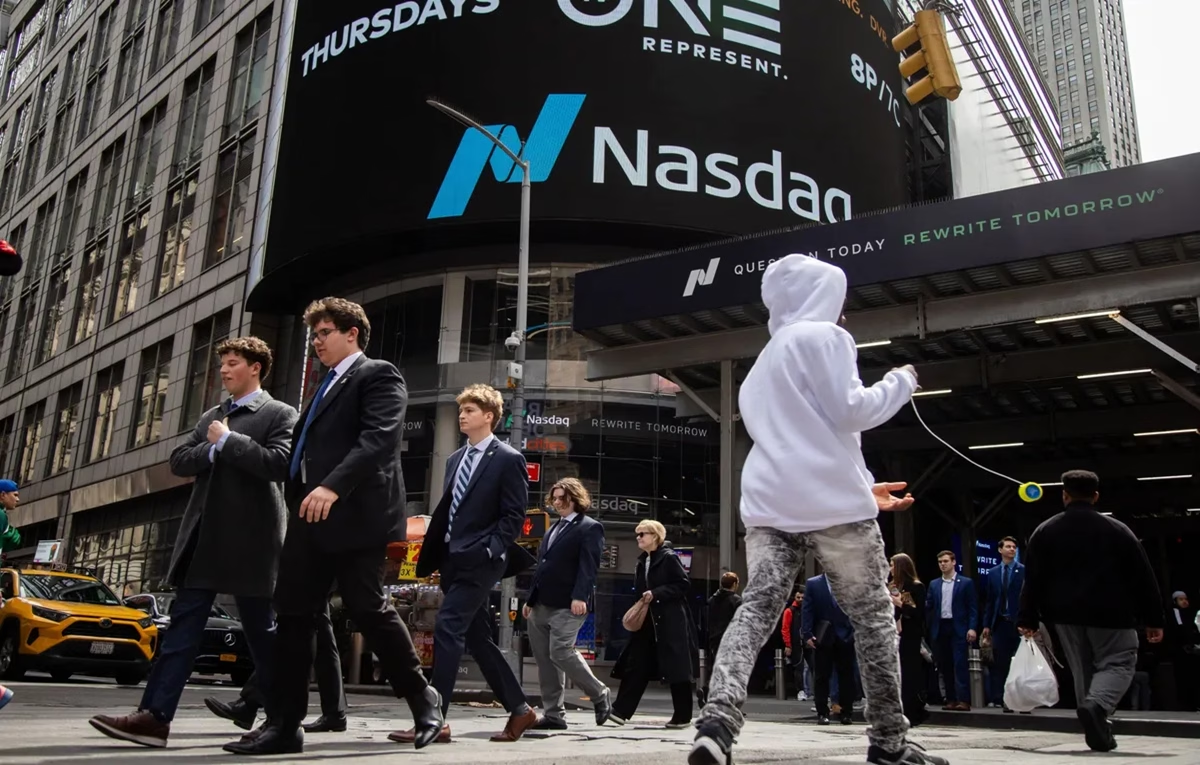
On Wall Street, the Dow Jones Industrial Average (^DJI) fell 0.4%, the S&P 500 (^GSPC) lost 0.7%, and the Nasdaq Composite slid 1.4% amid heavy selling in semiconductor and chip-related stocks.
The technology sector’s weakness followed Samsung Electronics (005930.KS) closing down 6.9% despite the South Korean firm forecasting a substantial rise in second-quarter profits.
Kathleen Brooks, research director at XTB, said: “Samsung earnings could be a warning sign to the US. Although the South Korean company delivered a 19-fold increase in Q2 profit year-on-year, the stock sunk… as investors get nervous about the sustainability of chip stock earnings power.”
Ipek Ozkardeskaya, senior analyst at Swissquote, added that the “ugly reaction to exceptional Samsung earnings is a reminder that, in richly valued markets, meeting expectations is no longer enough.”
The tech rout spread across Wall Street, with Intel falling 11%, Applied Materials dropping 9.8%, Marvell Technology shedding 9.7%, Lam Research declining 8.7%, and Micron Technology losing 7.6%.
Advanced Micro Devices fell 8.1% and Nvidia lost 1.5%, reflecting broad-based anxiety about the durability of the artificial intelligence-driven chip boom.
Oil prices crept higher after the British maritime security agency UKMTO reported that an “unknown projectile” struck an oil tanker off the coast of Oman near the Strait of Hormuz on Monday, sparking a fire onboard.
UKMTO later confirmed the tanker had sustained structural damage from an unidentified projectile in the Strait of Hormuz, though no casualties or environmental damage were reported.
David Morrison, senior analyst at Trade Nation, said the incident “renewed fears of a fresh escalation in hostilities between the US and Iran” and “reminded investors that the Strait of Hormuz remains a dangerous place to transit.”
Morrison added that oil appears “very oversold” at current levels, warning: “This isn’t to say that prices can’t fall further, or even that they must correct upwards significantly. But it is a warning that investors could experience a spike in volatility after a selloff which has lasted for the best part of seven weeks.”
Brent crude for September delivery rose to 73.88 dollars a barrel on Tuesday, up from 72.13 dollars on Monday, as the geopolitical risk premium returned to energy markets.
Shell (SHEL) was the standout performer on the FTSE 100, rising 3.4% after nudging up its second-quarter guidance for integrated gas production and reporting gas trading results were “significantly higher” than in the first quarter.
Shell expects second-quarter integrated gas output of 610,000 to 650,000 barrels of oil equivalent per day, up from prior guidance of 580,000 to 640,000 barrels, though still down from the 909,000 barrels recorded in the first quarter.
Mining stocks weighed on the index, with Fresnillo down 4.5%, Anglo American falling 4.6%, Antofagasta declining 3.3%, and Endeavour Mining shedding 2.7%.
On the FTSE 250, Keller surged 23% after flagging that 2026 revenue and underlying operating profit would be “materially” ahead of current market expectations of £3.15 billion and £223 million respectively.
ITV fell 7.3% after JPMorgan downgraded the broadcaster to “neutral” from “overweight,” with analyst Daniel Kerven saying: “ITV has not been able to secure the deal that we had hoped for,” describing the outcome as a “good deal for Sky.”